Nobody's an outlier in the Magic Kingdom

Here's an interesting piece about data tracking through transactional data, Disney World, and how gross the term "meatspace" is.

Disney has always kind of creeped me out with their business practices. They're phenomenally good at marketing, and not even in a behemoth-tech-company, you-need-the-new-ipad kind of way. They've just mastered the concept of presenting technology in minute and frictionless ways, even when the technology isn't directly beneficial to anyone but The Mouse. They couple these technologies with brute-force strategies. The Disney Vault strategy comes to mind: I know it's not really technology per se, but it's a unique strategy that only Disney seems to have any control over.

Island of nasty cats

Also interesting, but not about me: Baker Island.

It's a tiny atoll in the South Pacific. Used as a rough airstrip by the US in WWII, it was largely abandoned after the war and is now a nature refuge. The interesting thing is that it had a feral cat population for several decades despite being almost completely devoid of fresh water or foliage. Those must have been some dangerous cats.

See also: Meyerton, a former settlement on the island.

Unnecessary! exclamation! points!

Another day, another time for a self-assessment. Today I took the VIA Me! assessment. It's much like the Clifton Strengths Finder in that it is intended to identify a set of strengths. The test itself is a series of questions with no time limit. Questions can be answered using two options each for agreement or disagreement. There is also a neutral option. Unlike the Clifton assessment, the VIA assessment places all its questions right next to each other so it's rather obvious when intentionally redundant questions arise (i.e., "I often seek vengeance" and "I seldom hold grudges").*

The assessment itself is free. The results are not, unless you just want a list of strengths. I'm not going to fork over any cash for this stuff if I can avoid it, so the list is all I got.

Here are my results:
Character Strength # 1
Creativity
Thinking of new ways to do things is a crucial part of who you are. You are never content with doing something the conventional way if a better way is possible.

Character Strength # 2
Humor
You like to laugh and tease. Bringing smiles to other people is important to you. You try to see the light side of all situations.

Character Strength # 3
Judgment
Thinking things through and examining them from all sides are important aspects of who you are. You do not jump to conclusions, and you rely only on solid evidence to make your decisions. You are able to change your mind.

Character Strength # 4
Curiosity
You are curious about everything. You are always asking questions, and you find all subjects and topics fascinating. You like exploration and discovery.

Character Strength # 5
Love
You value close relations with others, in particular those in which sharing and caring are reciprocated. The people to whom you feel most close are the same people who feel most close to you.

These results appear to correlate very well with those from the Clifton assessment. The terminology differs, but Creativity and Ideation are more or less identical while Judgment/Curiosity appear to match with Analytical/Input. These results are quite interesting in that they also include humor and love. I'd like to think that one or both of those strengths are essential to everyone to some degree, but it's interesting that the other assessments I've taken appear to completely disregard them.

Overall: Free and fairly helpful for the time it demands (roughly 10 minutes, or maybe less if you're really focused). Including humor as a strength is a critical distinction!

*I don't know if folks who design psychological assessments intend to obfuscate redundancy. The redundancy is essential to reducing error, I think, but does it impact the results if the test subject is aware of the redundancy? Do they ensure that their answers are more consistent than they would be otherwise?
It's really nice to be able to stay focused on a single task for hours. It's less nice when there are other, equally pressing tasks to pursue. I need to find a way to balance my preference to work on a single thing with my tendency to grab bits n' pieces of information from as many sources as I can find. The usual result is that, upon taking a break from whatever I've been focusing on, I tend to go looking for other information about the task (i.e. I go googling for new methods) rather than shifting focus to something else entirely. It feels inflexible.

Back when I was in a different lab and a different building, I'd try to solve this problem by climbing stairs. My building had more than ten floors so this was some fairly decent exercise. Perhaps a short walk would serve the same purpose.

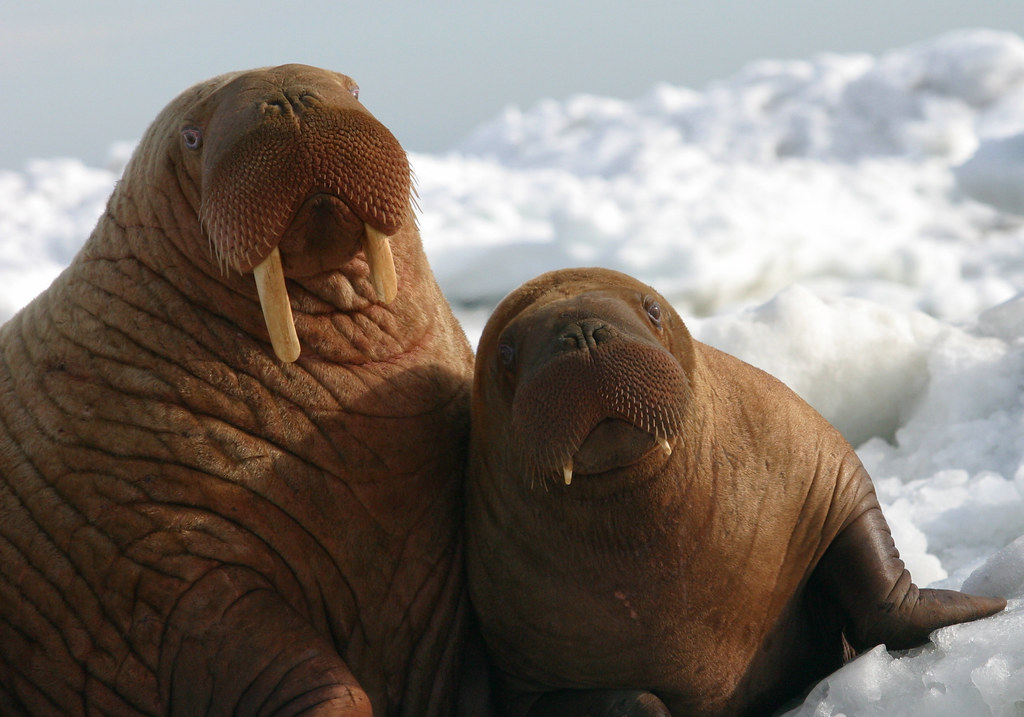
On an unrelated note: Walruses.
The photo is courtesy of the US Fish and Wildlife Service.
Wikitionary suggests the plural form may be "walrus".

Shades of grey

(Or maybe shades of gray, depending on where you are in space and what you're wearing.)

Stephen Hawking has proposed that black holes may not be what we think they are. That is, they aren't black. Or maybe not holes. Either way, Hawking has long had an issue with what happens to information and energy when it enters a black hole. It's a thorny issue which the above article handles much more aptly than anything I could discuss, so here are some summary quotes:
In place of the event horizon, Hawking invokes an “apparent horizon”, a surface along which light rays attempting to rush away from the black hole’s core will be suspended. In general relativity, for an unchanging black hole, these two horizons are identical, because light trying to escape from inside a black hole can reach only as far as the event horizon and will be held there, as though stuck on a treadmill. However, the two horizons can, in principle, be distinguished. If more matter gets swallowed by the black hole, its event horizon will swell and grow larger than the apparent horizon.
Conversely, in the 1970s, Hawking also showed that black holes can slowly shrink, spewing out 'Hawking radiation'. In that case, the event horizon would, in theory, become smaller than the apparent horizon. Hawking’s new suggestion is that the apparent horizon is the real boundary. “The absence of event horizons means that there are no black holes — in the sense of regimes from which light can't escape to infinity,” Hawking writes.
This doesn't make black holes - or whatever the best term for them is - nicer places to visit. Even if energy/information entering them isn't destroyed, it's still dispersed and disrupted. Hawking ends his brief paper on the subject with
One can’t predict the weather more than a few days in advance.