Today's music is Emancipator - Merlion.
I read this short piece by Wasim Salman today. It's another reminder that cyberpunk is dead because we're already living a post-cyberpunk existence. The piece doesn't make that influence subtle: it's framed using Neuromancer. At this point, direct Gibson references are futurist scripture.
A short note about a large building
/
There's a warehouse in Lacey, Washington State. It's 2 million square feet inside (more than 185,000 square meters, but that number isn't as startling). It's one of the largest buildings in the world. Target uses it to store imported merchandise prior to distribution.
Here it is on a Google Map. Zoom out a few times and you'll still be able to see it more clearly than anything else around.
Here it is on a Google Map. Zoom out a few times and you'll still be able to see it more clearly than anything else around.
It's not your (segmentation) fault
/
Hi there. It's time for a quick market segmentation break. I'm talking about how marketers categorize their audience into different groups, i.e., young people vs. old people or single people vs. families. This segmentation can get very high-resolution once behavioral data enters the picture. You've likely seen those surveys about soda brands and political affiliations.*
For a quick look at your own local market segmentation, plug your ZIP code into this Nielsen site.
My neighborhood is rich in Up-And-Comers (younger people with college educations, no kids, and hybrid Nissan Altimas). If you've seen a lot of targeted advertising in recent years, it's not entirely your fault. Blame your neighbors.
There are some clear comparisons to be made here between marketing demographics and microbial ecology. The taxonomy tends to be more clear-cut when it comes to microbial species, but both microbes and humans occupy specific niches for specific reasons. I'd also guess that, much as microbial cultures usually involve more than one species,** human societies rarely match any specific market segment. If they did, the segmentation model wouldn't be terribly useful.
I tend to be inherently distrustful of marketing but its methods could offer some novel insights into microbial communities.
*Also relevant from that survey: the question "Is Olive Garden Authentic?"
**Plus phage!
For a quick look at your own local market segmentation, plug your ZIP code into this Nielsen site.
My neighborhood is rich in Up-And-Comers (younger people with college educations, no kids, and hybrid Nissan Altimas). If you've seen a lot of targeted advertising in recent years, it's not entirely your fault. Blame your neighbors.
There are some clear comparisons to be made here between marketing demographics and microbial ecology. The taxonomy tends to be more clear-cut when it comes to microbial species, but both microbes and humans occupy specific niches for specific reasons. I'd also guess that, much as microbial cultures usually involve more than one species,** human societies rarely match any specific market segment. If they did, the segmentation model wouldn't be terribly useful.
I tend to be inherently distrustful of marketing but its methods could offer some novel insights into microbial communities.
*Also relevant from that survey: the question "Is Olive Garden Authentic?"
**Plus phage!
Of paper mountains and mysterious broths
/
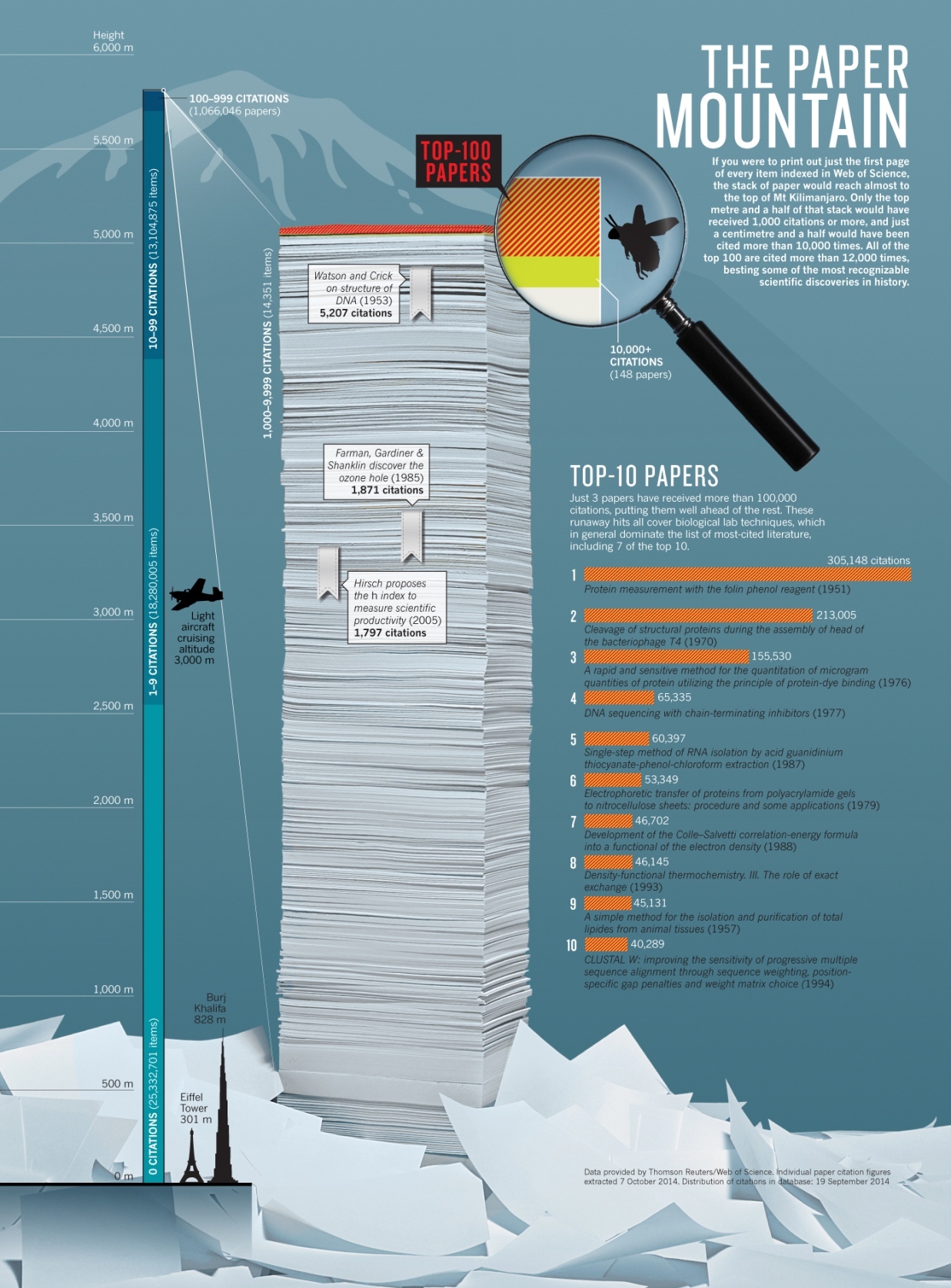
Nature has had a few articles lately about the most highly-cited research papers in existence. This infographic is part of the most recent analysis. The whole context can get a bit silly so I'm glad they approached it from more of a popular-science direction than a genuinely metatextual one. I'm also not a fan of most infographics so it's nice to see a clean, compact figure like this one or the interactive figure in the main article.*
There are few surprises here: the most frequently-cited papers are those offering novel scientific methods or easy implementations of those methods. The Altschul BLAST papers are a great example. They describe sequence comparison methods which are so easy to use and powerful that everyone from undergraduates to senior researchers still find them useful on a daily basis. Of course, methods eventually become common knowledge and people either stop citing them, replace them with newer methods, or just forget who created the methods in the first place. Laemmli buffer, described in a 1970 paper by its namesake,** is still used in proteomics studies, but so is LB medium, a recipe originally described as "lyosgeny broth" but often called "Luria-Bertani" medium after its creator, Giuseppe Bertani, and the microbiologist Salvador Luria.***
*Apologizes if you can't access content behind the paywall! I'm not sure if this article is broadly accessible but it really ought to be.
** Yes, that's right, the seminal paper by Dr. Buffer.
***The 1951 paper is here. This 2004 review offers a nice historical perspective.
There are few surprises here: the most frequently-cited papers are those offering novel scientific methods or easy implementations of those methods. The Altschul BLAST papers are a great example. They describe sequence comparison methods which are so easy to use and powerful that everyone from undergraduates to senior researchers still find them useful on a daily basis. Of course, methods eventually become common knowledge and people either stop citing them, replace them with newer methods, or just forget who created the methods in the first place. Laemmli buffer, described in a 1970 paper by its namesake,** is still used in proteomics studies, but so is LB medium, a recipe originally described as "lyosgeny broth" but often called "Luria-Bertani" medium after its creator, Giuseppe Bertani, and the microbiologist Salvador Luria.***
*Apologizes if you can't access content behind the paywall! I'm not sure if this article is broadly accessible but it really ought to be.
** Yes, that's right, the seminal paper by Dr. Buffer.
***The 1951 paper is here. This 2004 review offers a nice historical perspective.