In lieu of a real blog post, I'm going to post some terrible selections from 3500 Good Jokes for Speakers by Gerald F. Lieberman (or is it Robert Lieberman, as some sites list it? They may or may not be the same person).  It's only come to mind lately as I'm compiling one of those memetic Facebook book-lists.

I own a paperback copy of this book. As far as joke books go, it's a genuine relic, stuffed with the material I'm guessing was stale by at least a decade or two when the book was published in 1975. With that said, the collection consistently creates a cultural atmosphere, like a museum diorama of a circa-1961 lounge where men in carefully-considered suits smoke cigars and avoid pain.

Some selections:

  • I'm a stooge to no one man. I free-lance. 
  • The room they gave me was so small every time I bent over I rearranged the furniture.
  • You can tell the age of a horse by the teeth. But who wants to bite a horse?
OK, that last one isn't too bad.
I went to a poster symposium on the VCU medical school campus today. All the presenters were postdocs; the event was intended to coincide with National Postdoc Appreciation Week (see also: my rant in yesterday's blog post). A few highlights:

  • A postdoc from the Physics department told me about the jellium model. 
  • A postdoc from Pharmacology and Toxicology (and a former member of the personal development class I took this past Spring) told me about use of a DAGLβ inhibitor as a treatment for pain and inflammation. 
  • Another postdoc from the same department talked with me about a novel plant-derived chromone compound which may be useful in treating glutamate excitotoxicity.
  • Free lunch
And a few problems, since nothing is ever perfect:
  • Visitors appeared to be other postdocs - I didn't see many faculty, but I'm also not familiar with everyone on the medical campus. Postdocs are generally at a career position where they have accumulated extensive knowledge and have had more than a few opportunities to present it, so I'd argue that less advanced researchers (graduate students, or hey, even undergrads) would get more out of an event like this than they would from a symposium of their fellows.
  • Just a single poster was present from the Microbiology and Immunology department. I know that department has at least ten postdocs right now. It would have been nice to see more variety among the physics and biochemistry research.

Long days in the science mines

I heard this NPR piece about postdocs in the biomedical sciences today (correction: I started ranting about it halfway and didn't hear the second half). The basic idea is that, at least in this field, postdoc positions are rare, the researchers filling those positions are overworked and poorly compensated, and the situation isn't going to improve anytime soon. None of this is news to anyone doing biomedical research, whether they're a current grad student or a senior investigator. They know how the system works now.

OK, so "works" isn't the right work. This system is blatantly coercive. It takes advantage of the desire to do real, productive research and transforms that desire into raw labor. It's like a gold rush long after the rich veins have been depleted: you're still left with a bunch of laborers who can swing a shovel but won't strike it big anytime soon. Why not put them all to work more-or-less indefinitely? Otherwise, whole branches of science become ghost towns (though that's happening as well, and for similar reasons).

Part of the issue revolves around what postdoctoral researchers really are, at least in an official context. The NPR piece puts it like this:
The entire system is built around the false idea that all these scientists-in-training are headed to university professorships.
It's true that postdoctoral positions are intended as training. The NIH says they are "...engaged in a temporary period of mentored research and/or scholarly training..." as a means to a career goal. The postdocs I've talked to have expressed how this leaves them stuck between the role of a student and that of a mature, capable researcher. At universities, this means they don't get any of the benefits of studenthood (i.e., acknowledgement that specific training goals need to be met) but they certainly aren't university staff. It's often unclear who they really work for or whether they're even employees.*

In the end, we're left with more than 40 thousand people forced to sacrifice their intellectual and economic independence for years on end. This isn't just about the value of a doctorate. It's about a massive societal disconnect: science is something that everyone wants to do but no one wants to pay for.

Somehow, I'm remaining optimistic.


*That article is from more than a decade ago but I believe much of it still applies.

Not Amsterdam. Not Düsseldorf. It's Ochtrup.

OK, back to the recent travel recap! To review: the time is August 16 - about a month ago - and the place is Ochtrup, Germany. It isn't a place the lady and I would normally visit but we have friends who live there. That's not to say it isn't worth visiting: the area is authentically pastoral and rich in distinct agricultural character (i.e., hay hotels, which I will discuss later).
Downtown Ochtrup.
A flyer for the Schützenfest. I'm told it is a critical element of the local social (read: drinking) calendar.
Through a mirror, darkly, but only because it was a bit overcast.

Ochtrup isn't far from the border with the Netherlands, so it's also not far from the border city of Enschede. This city is famous for a fireworks warehouse explosion nearly 15 years ago but we primarily went there for the large outdoor market and the curious sensation of seeing all the road signs switch over from German to Dutch with little notice. It doesn't help that stop signs in the Netherlands stay STOP on them.
The market at Enschede. I'm not sure what those twisty metal structures are but the birds sure like them.
The lady finds her Backfisch. This market had more fresh fish than you could shake a squid at.
Here's some of that fish!
It's not all seafood. There are also buttons.
Also present: fries, the potato kind. They're just called patat, giving the impression you will be sold an entire potato.

Not shown: that evening, which I spent drinking with some delightful old ladies. They do enjoy their schnapps and bolle (the latter is primarily sparkling wine with fruit in it, much like sangria).

The next morning was time for a visit to the Ferienhof Laurenz. It's a working farm with a restaurant, accommodations (including the aforementioned hay hotel, which is essentially a hay loft one can legally sleep in), gift shop, and friendly animals. After an excellent brunch, we visited all those attractions, but mostly the animals. Farm tourism is a force of nature in Germany to an extent that's difficult to describe, but if you've ever visited Lancaster, PA then imagine that area's tourism strategy without its dependence upon religious minorities but with a greater emphasis on an ambiguous rural way of life.*

The brunch room. It's ready for Pinterest. Observe the many eggs.
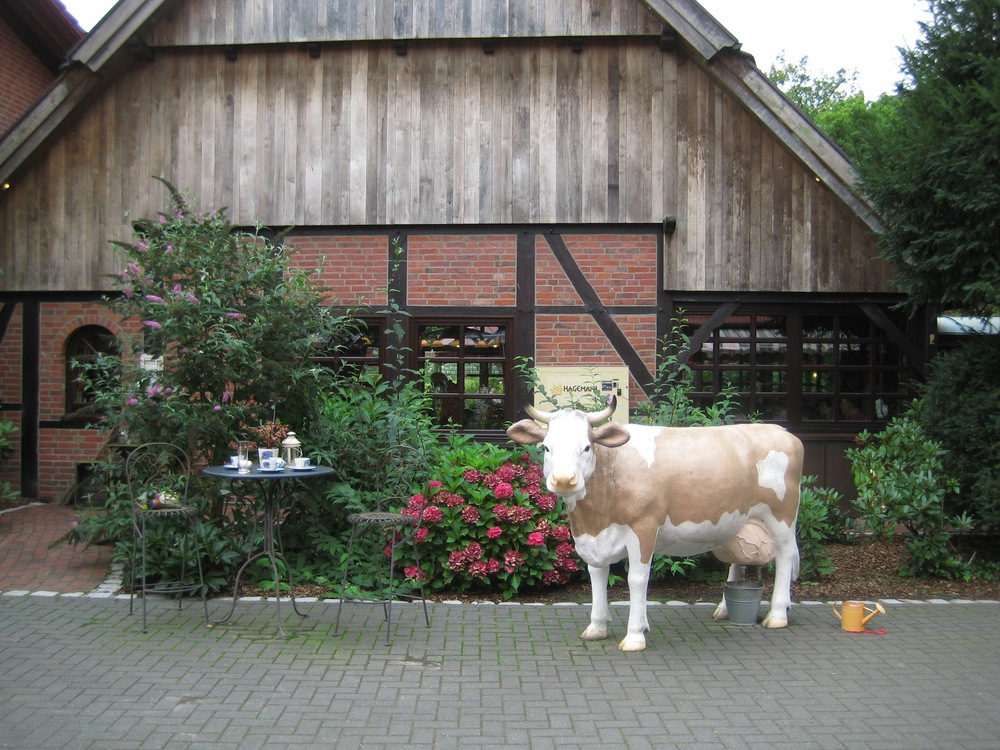
This cow is artificial.
Do not assume the cow is alive.
It's authentic! We would have purchased gourds but they're easier to get at home and difficult to get through Customs.
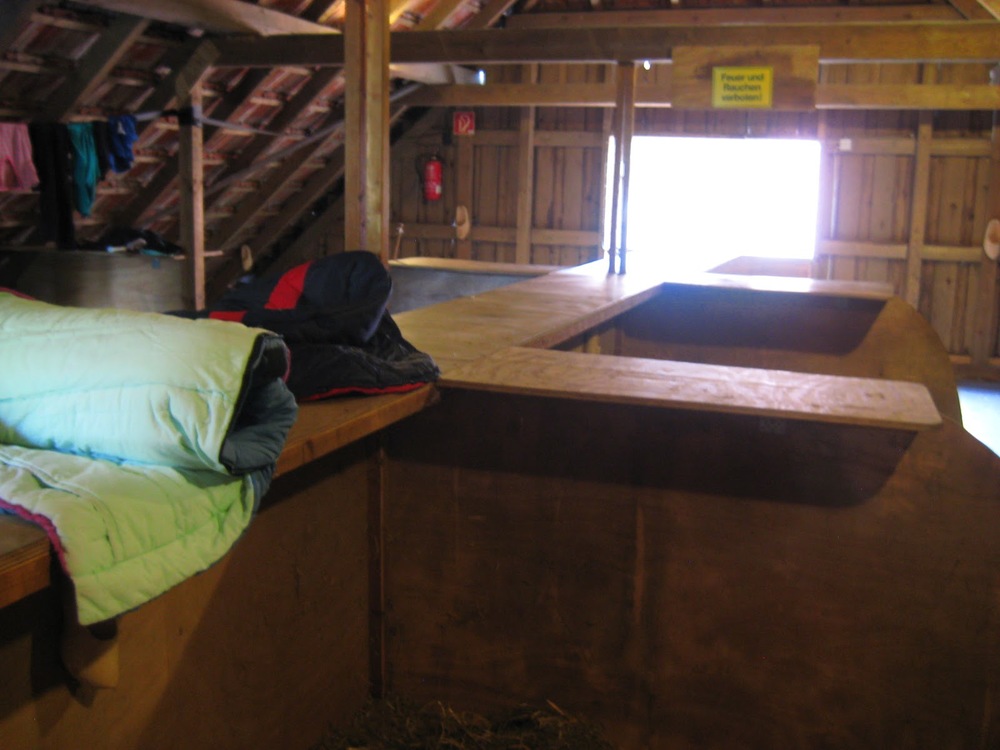
It's the Hay Hotel! It sleeps 40.
Hello there, goat. If you look closely, you can observe my reflection in the goat's eye.
It wasn't the right time of day for the Biergarten.
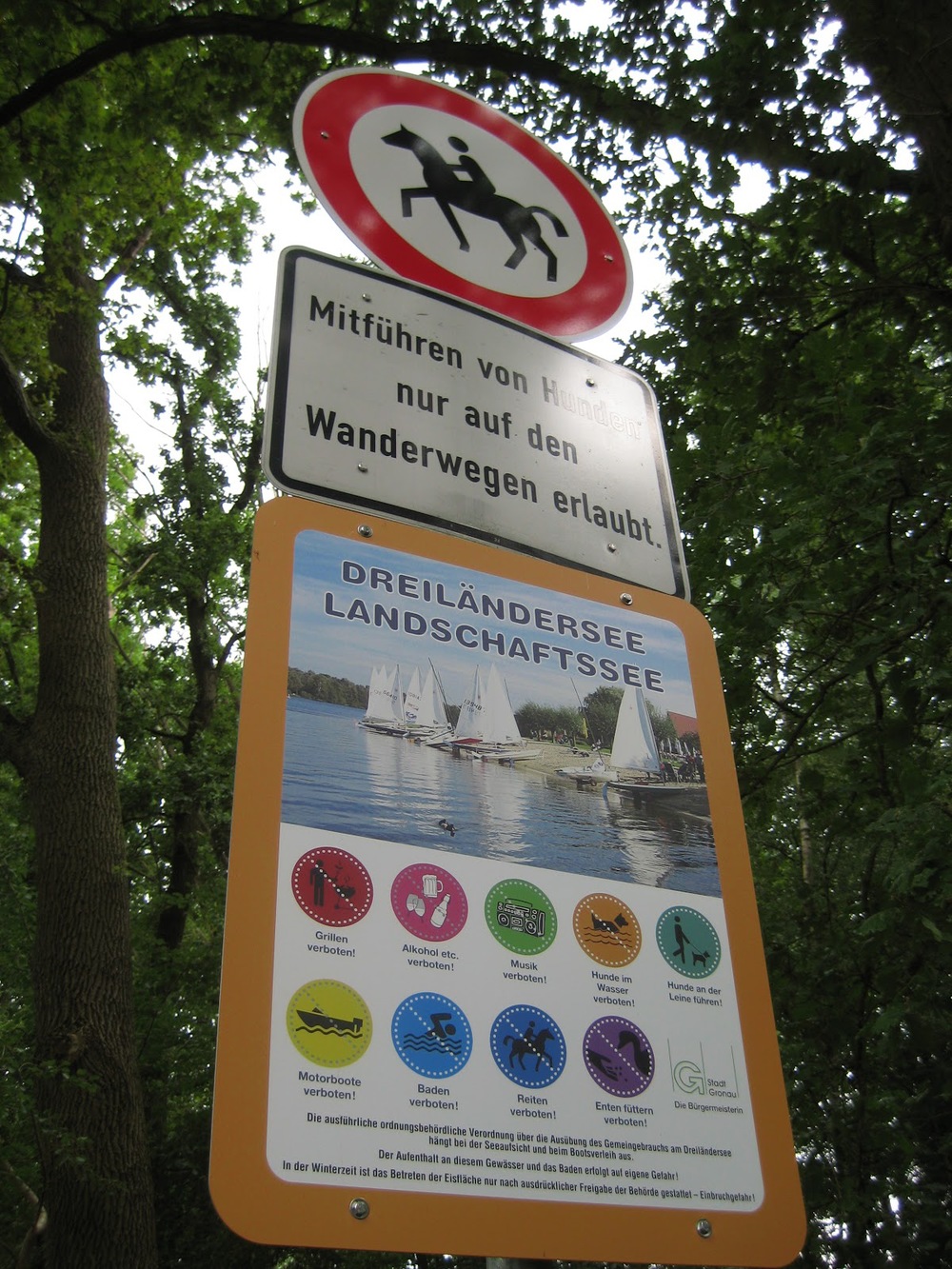
We stopped at the Dreiländersee after brunch. It's a popular lake, especially with camping tourists, though it's quite small - if it was any larger, it would be in the Netherlands (or Saxony, at least).
You can't quite See it yet.

Aha, there it is. The Dreiländersee, that is.
Next time: it rains quite a bit and we take a train back to the lowlands.

Bonus photo: Dutch home goods.

*I think this may be referred to as Hofleben in more than a few places, at least in the context of a Bauernhof (a farmstead). Hofleben looks like it can also mean "court life". Either way, your current lifestyle is likely not one of Hofleben.

It's been interesting to see the new features getting added to Google Now since I traded in Apple for Android more than a year ago. Some of the features, like traffic and weather updates, are genuinely useful. Others are less useful to me but are innocuous: my phone tracks any stock ticker I search for, even when I search for an acronym which is coincidentally listed on the NASDAQ. A few issues irritate me enough for a complaint-heavy blog entry:

  1. Flight updates. I'm still getting updates about flights I took weeks ago. On other occasions, notifications have contained incorrect flight times or have referred to the previous day's flight. These updates are misleading and distracting.
  2. Automatic directions. Ostensibly, this feature exists to grab directions to places where you want to go. In practice, it provides me with directions to every restaurant and attraction I've googled in the past day. Even worse, if I drive out of the state, Google Now starts suggesting trips to every now-local place I've visited in the last year. Some of those directions may be useful but they're difficult to extract from the list of false positives and routes I already know well. To make matters worse, Now tries to assign names to locations but usually can't guess if they're gas stations or office complexes (usually, they are neither). A street address would be just fine!
  3. Limited customization. The Google "cards" aesthetic is one that trades in minimalism. It works best when images are bold and lists are short. This is hard to accomplish when Now becomes a list of New Content Available. The problem could be easily solved with a single setting to control how many different items a card can hold, but the whole system is Apple-like in its planned simplicity. 
That being said, I like the overall Now concept, even if it's still reminding me about events in Amsterdam I couldn't see without a rather expensive plane ticket.